Saturday, 13 January 2018

Masada, Jewish and Christian Quarters

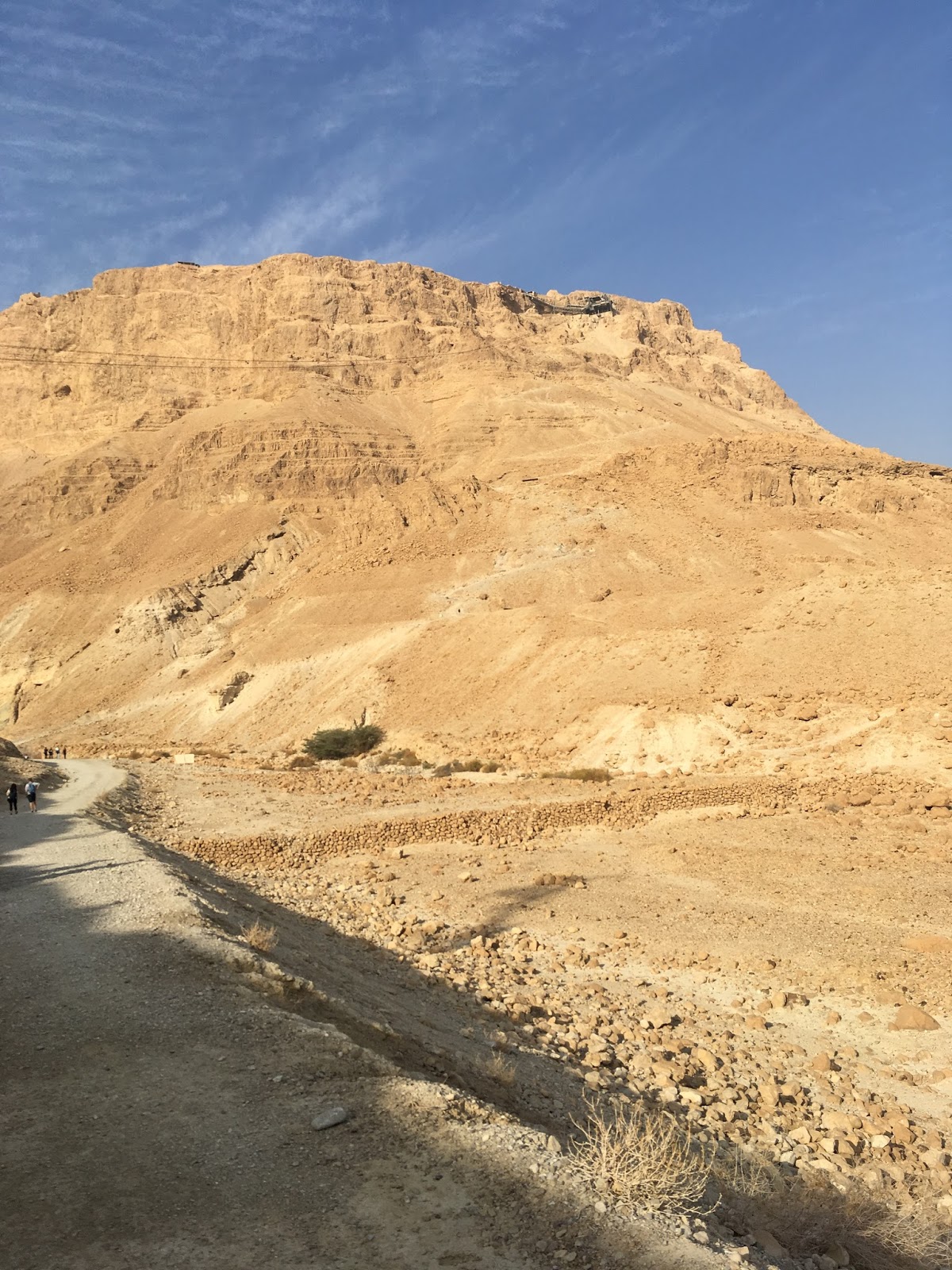
Today we finally went to Masada. The road had been repaired and we had no trouble getting through this time. Masada is an ancient fortress in the Judean Desert and it is on a massive rock plateau overlooking the Dead Sea. It has a cable car but also a long path known as The Snake Path winding up the mountain. It was built around 30BCE. Among the ruins are King Herod's Palace and a Roman-style bathhouse.

A few of us were a little scared of the cable car because it was so high so we decided to walk the path. Our tour guide tried to talk us out of it but we were determined to do it. The following photos are all from our adventure up the mountain. The first photo is the mountain itself.


I made friends with these little guys up the top. They were very friendly. The bird in the front let me scratch his head.


I was brave and took the cable car back down the mountain and then we ate lunch before getting back on the bus and returning to Jerusalem. Here Amir, our guide, took us on a tour of the Jewish and Christian Quarters. The following photos are from the Jewish Quarter. Compared to the rest of Jerusalem it is very clean and well kept.


This entrance to the Jewish Quarter is accessed from the Christian Quarter but because of Shabbat it remains closed.


The following photos are from the Christian Quarter. The first photo is the entry into the Christian Quarter from the Jewish Quarter.


Tomorrow we are off to Golan Heights where we are going to eat at a famous fish restaurant and go to a winery where we will have a tour and a wine tasting session. It will be a long day, leaving at 7.30am and returning to the hotel at 8pm.

Friday, 12 January 2018

Five days to go!

Today we began our morning lectures with a session delivered by one of the head journalists from the Jerusalem Post. He talked to us about the ins and outs of Israel's stability and the entire Middle Eastern region. It was fascinating and scary all at the same time. He showed us maps of the Middle East and spoke about the threats to Israel. He explained to us that Israel's biggest threat was from Iran and they would be in trouble if Syria were to fall because at the moment Syria is the only real 'buffer zone' between Iran transporting weapons into Lebanon, which is hostile to Israel and right on its border. As recently as the past few days rockets have been fired into Israel from the Sinai on the other side of the country by ISIS, who have a strong influence in the north of Egypt and are spreading through the Sinai. The Israeli Defence Force have a strong presence on the border between the Sinai and Gaza because ISIS and Hezbollah were beginning to tunnel weapons under the borders. He explained to us that when Israel initially moved away from Gaza and allowed the Palestinians control they were overrun by Hezbollah and he said that Israel learnt a lesson when this happened. That is why they are happy to allow the Palestinians to control the West Bank but will never remove their military presence because if Hezbollah, ISIS or any of the other terror factions were to again take control it would be a disaster for Israel. He also said that hostilities were also high in the Golan Heights and there has been rocket fire that has made Israeli landfall as well over the last few days. This made us a little nervous as we are heading north on Sunday and travelling along the Golan Heights area. However, we spent a day in Tel Aviv last weekend which is only 92kms away from the Gaza Strip and we were fine. Of course we were only hearing one viewpoint but it was still great to have a better understanding of the situation in the country. Netanyahu is not a well liked leader because he is not too concerned about his people, evidenced by the constant protests on the corner right outside my hotel, but he continues to be voted in because he is the only leader who has been able to secure the Israel borders. His focus according to the journalist is security alone. He gave us lots of facts and figures and numbers of deaths, injuries and terror attacks have reduced significantly over his multiple tenures.


Members of our group who hadn't gone through the West Bank did so this afternoon and came back with lots of tales of hearing and seeing gunshot and fighting. There was a drive by shooting in the West Bank the other day in which a Rabbi died and this has caused tension.

It is Shabbat today so we finished school at 11.15am and when we returned to the hotel a few of us went for a walk along the Old City Wall. On our way back there weren't a lot of locals about because of the Sabbath but because it is the time when the Jewish people visit the holy sites there are a lot of police at all the checkpoints.


This Jewish man was busking in the Mamilla Mall. He was very good! Seeing an Orthodox Jew with side curls working on the Sabbath is highly unusual so perhaps he was just cashing in on the novelty factor for tourists. His guitar case was full of money.


Here are some spices just for the sake of it. I like taking photos of spices.


Before dinner tonight a few of us went to the Synagogue to welcome in the Shabbat and then the whole group met for Shabbat dinner at the hotel along with all the other Jewish families who came to the hotel. The Synagogue was very busy tonight and there was a gospel choir singing throughout the service so it was really lovely.

Heading to Synagogue in my new jacket.


We have a half day tour of Masada tomorrow morning and then a guided tour in the afternoon of the Jewish and Christian Quarters. Off to bed now!

Thursday, 11 January 2018

The Children's Memorial

Well, today was quite a day! We started with two lectures; one on The Decision to Kill the Jews - The Final Solution and Its Implementation and the other asking and attempting to answer the question "How Was It Humanly Possible?" Both very heavy topics. After lunch we visited the Children's Memorial. The memorial was beautifully designed but the knowledge that one and a half million innocent children were murdered in the Holocaust was too much for most of the group. To enter the memorial you walk through a picturesque garden and as soon as you enter you walk through in darkness. Everybody entered with dry eyes and everyone was crying on the other side. The first haunting images you are greeted with are the faces of lost children as you enter the memorial. As you walk through the memorial you move through a section that is filled with what looks like starlight all around you and haunting voices read out the names of the deceased children and their ages. It was incredibly moving.


After the memorial we went back into the classroom to learn about an educational unit called the Auschwitz Album. It follows the progress of one transportation to Auschwitz in 1944 and uses photographs, letters and testimonies as historical documents. The content of this lecture was deeply upsetting and we left school today feeling totally deflated.

Before we went home we did go for a tour through the Holocaust Art Museum and amidst all the discussion of death and destruction we saw the art works that victims created in the ghettos in defiance of their oppressors. Victims created art to leave some testimony of what life was like for them in the ghettos.


This final picture was drawn by a 16 year old boy who imagined what it might be like to live on the moon and look up at the Earth that he had escaped.


This was a very quick tour and I will go back on Monday and spend more time really enjoying the artworks on display.

The second lecture on "How Was It Humanly Possible?" was about the annihilation of the Jews throughout Europe and how the Germans exterminated Jews throughout Europe. The Professor who gave this lecture is completing a project that tracks each and every deportation from beginning to end throughout Europe and he spoke of many of his current projects and one of his recent tasks was to track the deportation of the Macedonian Jews, in particular those from Florina. As my grandparents are from this area I thought it might be interesting to do a little of my own research. I found out that Macedonian Jews were rounded up and taken in late April 1943 and the train arrived in Auschwitz on May the 7th 1943. Upon arrival 538 Jews from Florina were murdered in the gas chambers. The following photos are from The Valley of the Communities and Florina is represented by Skopje (on the wall it is written as Skoplje). The region back then was called Thessaloniki. I have included photos of all the walls from this region in case anybody back home knows of any of these other village names.


When we got back to the hotel a few of us went back into the Old City and bought a few more souvenirs and then we went and had a pasta dinner for a change from the hotel buffet. Yum! As you can see the Old City was very quiet tonight. We mostly saw army and police and very few tourists or locals.


Tomorrow we have a short day at school as it is Shabbat and then some of us will attend Synagogue in the late afternoon before the Shabbat feast at the hotel. Tomorrow we are told that there will be a live choir singing at the service. In the afternoon I will have a much needed rest and begin to write my proposal. Nearly there!!

Wednesday, 10 January 2018

Survivor Testimonies

Today at Yad Vashem we began with two lectures; The Decision to Kill the Jews - 'The Final Solution and Its Implementation' and "How Was It Humanly Possible?" After lunch however, we came to the highlight of the day. We met and heard the testimonies of four Holocaust survivors and then broke into smaller groups where we were able to talk with them and ask any questions that we had. One of the aims in providing these teacher training scholarships to Israel is to educate us in the stories of the survivors. As more and more survivors sadly pass, their stories go with them and so does their legacy. The survivors we met were Rena Quint from Poland, Daniel Gold from Lithuania, Yehudit Kleinman from Italy and Tibi Ram from Slovakia. We heard stories of horror and terrible choices that these people as young children in the Holocaust had to face just to survive. Most of these survivors came out of the Holocaust with entire families gone and completely alone. Despite the traumatic events that I can't even begin to understand they have continued to live productive and happy lives, they have children, grandchildren and great-grandchildren. When I asked Rena, as a survivor, what legacy she would like us to pass on to our students in Australia she said, "Tell our stories. Teach your students to solve problems without war. We should do everything in our power to make sure that there is peace, never war. We should learn to be tolerant." The other thing that struck me was that all the survivors said that if they had a place to call home in 1938 the Holocaust may never have happened. I finally had some understanding of why the land of Israel is so incredibly important to the Jews. As they said everyone needs a land to call home and I was saddened to realise that these survivors are unlikely to see that peace in this country in their lifetimes.

The following photo is my Yad Vashem 'family' and the survivors. The four seated survivors are from left to right: Daniel, Tibi, Yehudit and Rena.


After the session today they didn't just pile us on the bus back to the hotel as usual, we had an extra hour after the survivors left to debrief. We heard some really distressing testimonies so it was really good to talk and for some of us, to have a cry or ask for a hug. I call these teachers my Yad Vashem 'family' because we look after each other just like a family. As we are all so far away from home and in an environment that can be quite unnerving at times we have formed special bonds.

When we returned people headed out in all different directions. Some stayed at the hotel for an early dinner and early bedtime and others went out to drink away their stresses. Many called home (even though it was the middle of the night) to talk to their loved ones because they were so distressed. I (along with a few others - don't worry Mum, I didn't walk the night streets alone) went to the Mahane Yehuda open air market, affectionately known to Israeli's as The Shuk. The market has more than 250 vendors who sell fresh fruits and vegetables, baked goods, fish, meat and cheeses, nuts, seeds and spices, wines and liquors, clothing and shoes, housewares and textiles. Following are photos from this market.


On Friday before the Shabbat is welcomed in, you can barely move in this market as all the Jewish people are stocking up for their Shabbat feasts. I think I will go just to experience the atmosphere.